Math
Math requires an understanding of Sections and Paragraphs.
Intro
- To add math, create a
Mathobject - Add
MathComponentsinsideMath MathComponentscan have nestedMathComponentsinside. e.g. A fraction where the numerator is a square root, and the denominator as another fraction. More onMathComponentsbelow- Make sure to add the
Mathobject inside aParagraph
Example
new Math({
    children: [
        new MathRun("2+2"),
        new MathFraction({
            numerator: [new MathRun("hi")],
            denominator: [new MathRun("2")],
        }),
    ],
}),
This will produce:
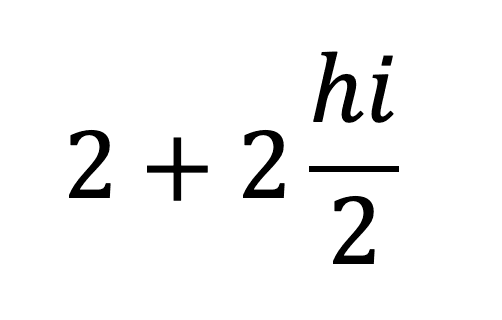
Math Components
MathComponents are the unit sized building blocks of an equation in docx. A MathComponent takes in more nested MathComponents until you reach MathRun, which has no children. MathRun is similar to a TextRun.
Math Run
MathRun is the most basic MathComponent.
Example
new MathRun("2+2");new MathRun("hello");An example of it being used inside Math:
new Math({
    children: [
        new MathRun("2"),
        new MathRun("+"),
        new MathRun("2"),
    ],
}),
Math Fraction
MathFractions require a numerator and a denominator, which are both a list of MathComponents
Example
new MathFraction({
    numerator: [new MathRun("1")],
    denominator: [new MathRun("2")],
}),
new MathFraction({
numerator: [
new MathRun("1"),
new MathRadical({
children: [new MathRun("2")],
}),
],
denominator: [new MathRun("2")],
}),An example of it being used inside Math:
new Math({
    children: [
        new MathFraction({
            numerator: [new MathRun("1")],
            denominator: [new MathRun("2")],
        }),
        new MathRun("+"),
        new MathFraction({
            numerator: [new MathRun("1")],
            denominator: [new MathRun("2")],
        }),
        new MathRun("= 1"),
    ],
}),
Sum
A MathComponent for Σ. It can take a superScript and/or subScript as arguments to add MathComponents (usually limits) on the top and bottom
new MathSum({
    children: [new MathRun("i")],
}),
new MathSum({
children: [
new MathSuperScript({
children: [new MathRun("e")],
superScript: [new MathRun("2")],
})
],
subScript: [new MathRun("i")],
superScript: [new MathRun("10")],
}),Integral
A MathComponent for the ∫ symbol. Like MathSum, it takes optional superScript and/or subScript arguments for the integration bounds. The bounds are rendered beside the integral sign.
new MathIntegral({
    children: [new MathRun("x dx")],
}),
With bounds:
new MathIntegral({
    children: [
        new MathSuperScript({
            children: [new MathRun("x")],
            superScript: [new MathRun("2")],
        }),
    ],
    subScript: [new MathRun("0")],
    superScript: [new MathRun("1")],
}),
Radicals
A MathComponent for the √ symbol. Examples include, square root, cube root etc. There is an optional degree parameter to specify the number of times the radicand is multiplied by itself. For example, 3 for cube root.
new MathRadical({
    children: [new MathRun("2")],
}),
Cube root example:
new MathRadical({
    children: [
        new MathFraction({
            numerator: [new MathRun("1")],
            denominator: [new MathRun("2")],
        }),
        new MathRun('+ 1'),
    ],
    degree: [new MathRun("3")],
}),
Super Script
MathSuperScripts are the little numbers written to the top right of numbers or variables. It means the exponent or power if written by itself with the number or variable.
new MathSuperScript({
    children: [new MathRun("x")],
    superScript: [new MathRun("2")],
}),
An example with cosine:
new MathSuperScript({
    children: [new MathRun("cos")],
    superScript: [new MathRun("-1")],
}),
Sub Script
MathSubScripts are similar to MathSuperScripts, except the little number is written below.
new MathSubScript({
    children: [new MathRun("F")],
    subScript: [new MathRun("n-1")],
}),
Sub-Super Script
MathSubSuperScripts are a combination of both MathSuperScript and MathSubScript.
new MathSubSuperScript({
    children: [new MathRun("test")],
    superScript: [new MathRun("hello")],
    subScript: [new MathRun("world")],
}),
Pre-Sub-Super Script
MathPreSubSuperScripts place the scripts to the left of the base instead of the right. Both subScript and superScript are required.
new MathPreSubSuperScript({
    children: [new MathRun("x")],
    superScript: [new MathRun("14")],
    subScript: [new MathRun("6")],
}),
Function
MathFunctions are a way of describing what happens to an input variable, in order to get the output result. It takes a name parameter to specify the name of the function.
new MathFunction({
    name: [
        new MathSuperScript({
            children: [new MathRun("cos")],
            superScript: [new MathRun("-1")],
        }),
    ],
    children: [new MathRun("100")],
}),
Brackets
Square brackets
new MathSquareBrackets({
    children: [
        new MathFraction({
            numerator: [new MathRun("1")],
            denominator: [new MathRun("2")],
        }),
    ],
}),
Round brackets
new MathRoundBrackets({
    children: [
        new MathFraction({
            numerator: [new MathRun("1")],
            denominator: [new MathRun("2")],
        }),
    ],
}),
Curly brackets
new MathCurlyBrackets({
    children: [
        new MathFraction({
            numerator: [new MathRun("1")],
            denominator: [new MathRun("2")],
        }),
    ],
}),
Angled brackets
new MathAngledBrackets({
    children: [
        new MathFraction({
            numerator: [new MathRun("1")],
            denominator: [new MathRun("2")],
        }),
    ],
}),
Limit
Limit Upper
new MathLimitUpper({
    children: [new MathRun("x")],
    limit: [new MathRun("-")],
}),
Limit Lower
new MathLimitLower({
    children: [new MathRun("lim")],
    limit: [new MathRun("x→0")],
}),